Solar eclipse could trigger unfortunately timed inflation spike

Solar eclipses are fascinating and many are eager to see them. On 12 August, a total solar eclipse occurs will be clearly visible in western Iceland, including the capital region. It can be expected that there will be both an influx of foreign tourists to the country, as well as a stream of locals travelling westward to get a better view. Since there is more demand than supply, this is likely to result in significant price pressure on services for travellers. Prices for flights to Iceland, accommodation and car rentals are substantially higher in the days surrounding the eclipse and many are already sold out. In addition, increased demand for restaurants and campsites can be expected in the areas where the eclipse will be visible.
Increased turnover in eclipse areas
Two total solar eclipses have been visible in the United States in recent years (2017 and 2024) with clear economic effects. The 2024 eclipse followed a narrow path across the entire US and people flocked to those areas, with a corresponding impact on retail, hospitality and other sectors.
The solar eclipse in August will be visible in western Iceland and the greatest pressure can be expected in the West Fjords, Snæfellsnes and the outermost parts of the Reykjanes Peninsula, where the eclipse will last the longest. The eclipse will also be clearly visible from the capital region and last for around one minute.
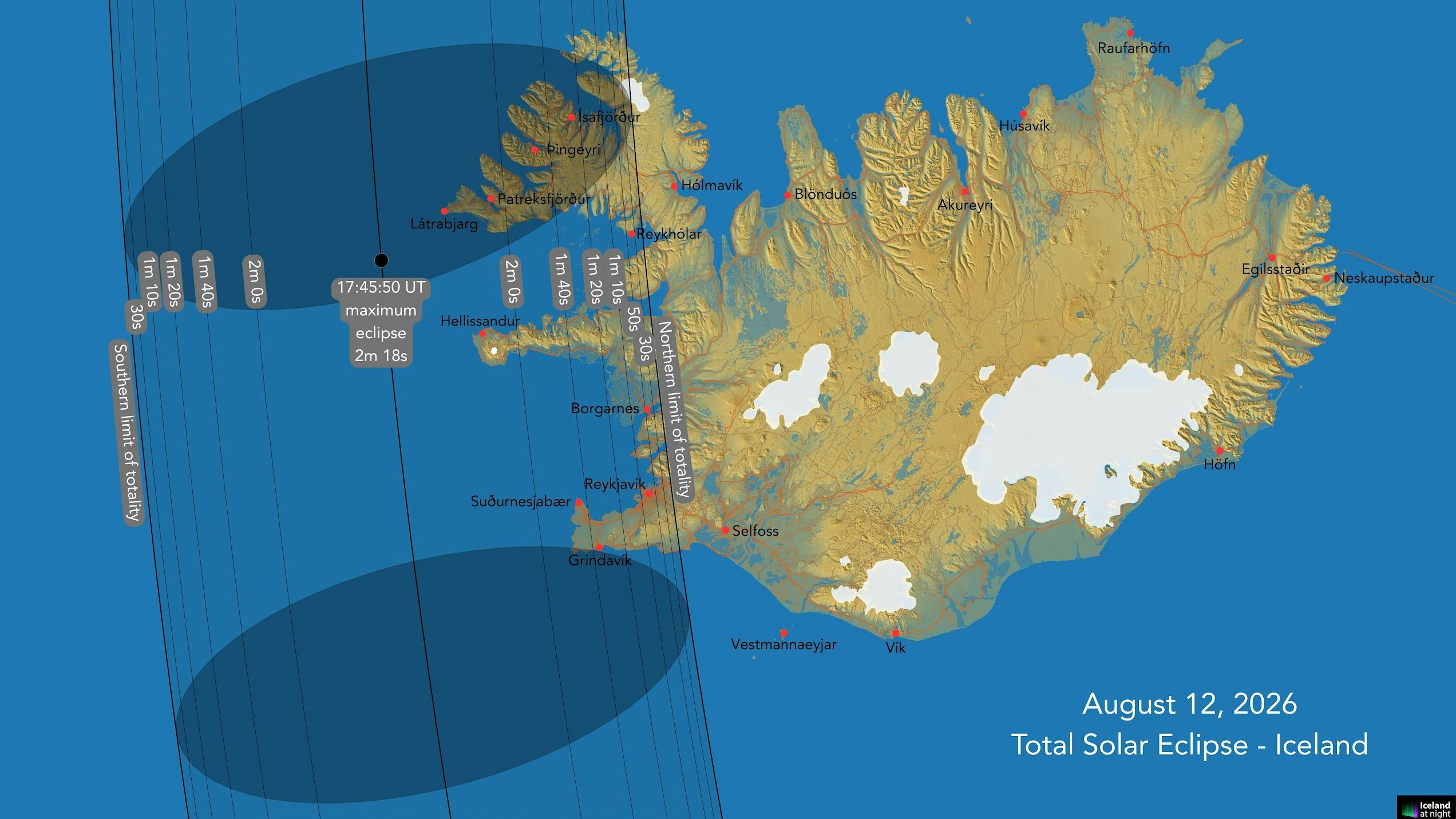
Total solar eclipse
Image: Andreas Dill & Sævar Helgi Bragason for solmyrkvi2026.is & icelandatnight.is
“Taylor Swift effect”, spike rather than inflationary pressure
It is not uncommon for major events to affect price measurements. The “Taylor Swift effect” is well known and in a nutshell means that in places where she performs, there is typically a substantial increase in local turnover in the tourism sector. Hotels fill up and restaurants experience increased demand, so it is not surprising that prices for those services rise, even enough to impact inflation measurements. Taylor Swift held three concerts in Stockholm in May 2024 and around 150,000 fans flocked to the city. Hotel prices surged, playing a major role in inflation that month measuring significantly above market expectations.
It is fairly likely that the solar eclipse will affect inflation measurements in August. The effects will also be fairly noticeable, since the eclipse occurs in the middle of Statistics Iceland’s price collection week. Airfares, accommodation and restaurants prices, car rentals and similar services can be expected to be more costly than usual. The tourist sector accounts for around 5.2% of the Consumer Price Index. An inflation spike like this is not driven by underlying economic factors, but simply by price increases caused by a major event, with prices most likely falling again immediately afterward.
Bad timing
It can be argued that the eclipse is occurring at the worst possible time from an economic perspective. First, August is generally the peak tourism month each year. The economic benefit from the influx in tourists will therefore be smaller than if the eclipse were, for example, to occur sometime during the off-season winter months.
In addition, there is a revision provision in collective bargaining agreements that is triggered if inflation measures above 4.7% in August. As things stand, the August CPI measurement could go either way. Even if the eclipse’s impact on inflation measurements would not necessarily be very large, it could still be enough to trigger the provision. In many respects, August is therefore the worst possible month for a solar eclipse in Iceland.
Fyrirvari
Innihald og form þessarar greiningar er unnið af starfsfólki Greiningardeildar Landsbankans hf. (greiningardeild@landsbankinn.is) og byggist á aðgengilegum opinberum upplýsingum á þeim tíma sem greiningin var unnin. Mat á þeim upplýsingum endurspeglar skoðanir starfsfólks Greiningardeildar Landsbankans á þeim degi þegar greiningin er dagsett, en þær geta breyst án fyrirvara.Landsbankinn hf. og starfsfólk hans taka ekki ábyrgð á viðskiptum sem byggð eru á þeim upplýsingum og skoðunum sem hér eru settar fram, enda eru þær ekki veittar sem persónuleg ráðgjöf fyrir einstök viðskipti.
Bent skal á að Landsbankinn hf. getur á hverjum tíma haft beinna eða óbeinna hagsmuna að gæta, ýmist sjálfur, dótturfélög hans eða fyrir hönd viðskiptavina, s.s. sem fjárfestir, lánardrottinn eða þjónustuaðili. Greiningar eru engu að síður unnar sjálfstætt af Greiningardeild Landsbankans og innan Landsbankans eru í gildi reglur um aðskilnað starfssviða sem eru aðgengilegar á vef bankans.